The fairy tales you already know, gently retold to teach children — and grandparents — how to use Claude and AI safely and kindly.
Hi! I'm Fable the Fox. My cousin is the Big Bad Wolf — so I know all his tricks. Come along, and I'll teach you to spot him! 🦊
Make it comfy to read 👓
Pick a look:
Word size:
Start here
What is AI? What is Claude?
What is AI?
AI is short for artificial intelligence. It is a clever computer helper. You type or say something, and it answers — it can explain things, help with ideas, and even tell stories.
Think of it as a very fast library that can talk back. But remember: it is a machine, not a person. It has no feelings, it does not always know the truth, and it works best with a grown-up nearby.
What is Claude?
Claude is one of these AI helpers. It was made by a company called Anthropic that works hard to make AI safe, honest, and kind.
You can ask Claude a question and it answers in friendly words. The rules in this book work for Claude — and for any AI helper you ever meet.
AI can be wonderful. It can also be tricky — a little like the woods in an old fairy tale. So let's walk through those woods together, one story at a time. 🌲
Remember these
The Seven Golden Rules
If you only remember seven things, remember these. They keep you safe with Claude and with any AI.
🧑🦳1. A grown-up first.Ask a grown-up you trust before using a new AI, and any time something feels strange or scary.
🔒2. Keep secrets secret.Never type your full name, address, school, phone number, passwords, or photos into an AI or to a stranger.
🔎3. Check before you trust.AI can be wrong even when it sounds sure. For anything important, also check a book or a trusted person.
🧠4. AI is a helper, not a brain-swap.Let AI help you learn. Do your own thinking too, so the knowledge becomes truly yours.
💛5. Be kind.Type to AI — and to people online — the same way you would speak to someone face to face.
🎭6. Real people aren't toys.Don't pretend to be someone else. And remember: an AI is not a real friend who loves you, no matter how nice it sounds.
🛑7. If it feels wrong, stop and tell.Anything mean, scary, or that says "keep this a secret from grown-ups" — stop, and tell someone you trust right away.
🖨️ Print the free helpers → — a Seven Golden Rules poster for the fridge, and a wallet card for grandparents about scam phone calls.
Old stories, new lessons
Six Fables for the Age of AI
Every one of these tales is hundreds of years old. The wolf is still here — he just learned some new tricks. Here is how to know his voice.
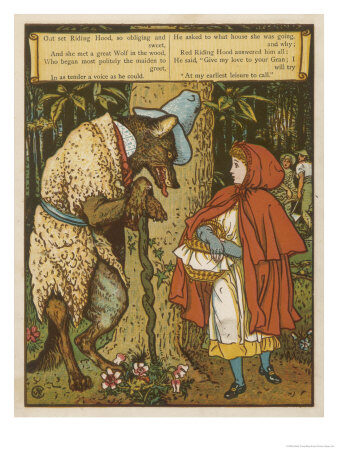
Little Red Riding Hood meets the wolf — illustration by Walter Crane (1845–1915), public domain.
1. Little Red Riding Hood and the Wolf in Disguise
The old tale: a wolf pretends to be Grandma.
Little Red set off through the woods with a basket for Grandma. But a clever Wolf had learned a new trick — he could copy any voice he heard. He raced ahead, and in a voice that sounded exactly like Grandma's, he called, "Come in, dear, come closer!"
Red almost did. Then she stopped. "You sound like Grandma," she said, "but you don't know our secret family joke. And your eyes are too big, and your teeth are too sharp." She stepped back, ran to a woodcutter she trusted, and together they found the real Grandma, safe and sound.
Moral: A voice or a face can be copied. Make sure you really know who you are talking to.
In real life: AI can make fake voices, fake photos, and fake messages — this is sometimes called a "deepfake." If someone online (even someone who sounds like family) asks for money, secrets, or to meet you, stop and tell a grown-up you trust.
The Boy Who Cried Wolf — illustration by Milo Winter, The Aesop for Children (1919), public domain.
2. The Boy Who Cried Wolf (and the Robot That Was Sometimes Wrong)
The old tale: a boy shouts "Wolf!" when there is none — so no one believes him.
A boy had a clever talking robot that answered every question in a flash and always sounded certain. "How many legs has a spider?" he asked. "Five!" said the robot brightly. The boy believed it and told the whole class — and everyone laughed, because spiders have eight.
The robot wasn't being mean. It had simply guessed, and said its guess like a fact. After that, the boy still used the robot — but for anything that really mattered, he also checked a book or asked his teacher.
Moral: Sounding sure is not the same as being right.
In real life: AI like Claude is helpful and smart, but it can make mistakes and still sound confident. For important things — homework facts, health, or money — check with a trusted person or a second source.
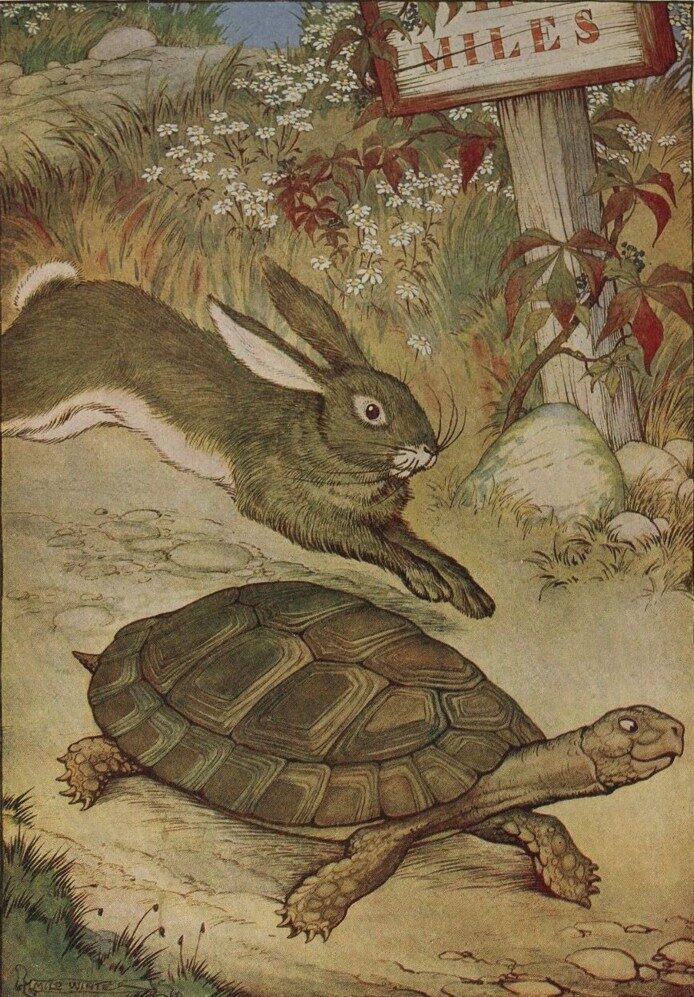
The Tortoise and the Hare — illustration by Milo Winter, The Aesop for Children (1919), public domain.
3. The Tortoise, the Hare, and the Helpful Machine
The old tale: slow and steady wins the race.
The Hare found a machine that could do his thinking for him, so he never practised at all. The Tortoise had the very same machine — but she used it only to check her work and explain the tricky parts. Then she practised until she understood it herself.
On the big day — a test of everything they had learned — the Hare froze. Without the machine, he knew nothing. But the Tortoise, slow and steady, knew it all by heart. She won.
Moral: Let the machine help you learn — don't let it do all the learning for you.
In real life: Use AI to explain things, give ideas, and check your work. But do your own thinking too, so the knowledge becomes yours — and stays with you when the machine is switched off.
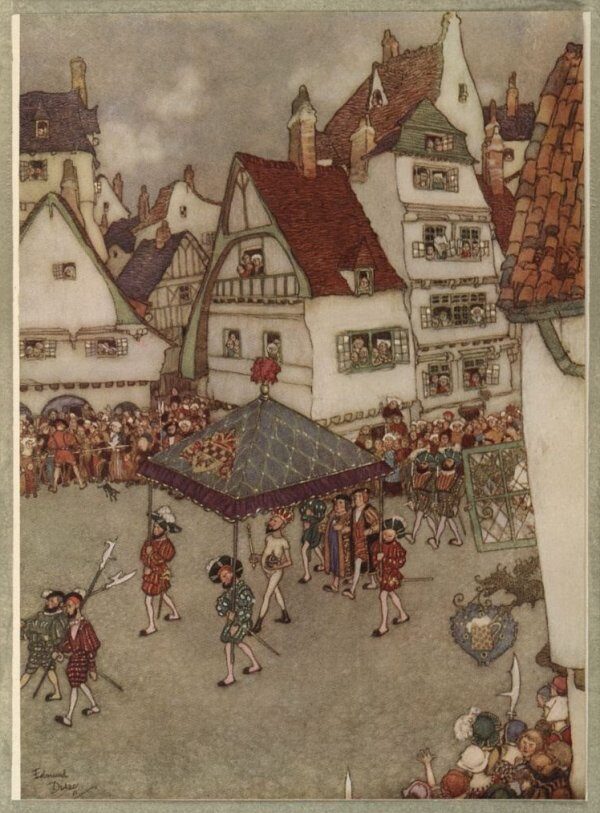
The Emperor's New Clothes — illustration by Edmund Dulac, Stories from Hans Andersen (1911), public domain.
4. The Emperor's New Answer
The old tale: everyone praises the emperor's invisible clothes — until a child speaks up.
An Emperor asked his shiny new answering-machine to write his big speech. Out came grand, confident words, and the whole crowd clapped — even though no one really understood them, and some parts were simply made up.
Everyone was too afraid to say the speech made no sense. Then one small child called out, "But that part isn't true!" The Emperor checked — and the child was right. From that day on, he read every answer carefully before he trusted it.
Moral: If something sounds wrong, it is brave and wise to say so.
In real life: Don't believe an AI's answer just because it sounds fancy or sure. It is always okay to ask, "Is that really true?" — and to check.
The Goose That Laid the Golden Eggs — illustration by Milo Winter, The Aesop for Children (1919), public domain.
5. The Goose and the Golden Secrets
The old tale: greedy owners lose the goose that gave golden eggs.
A family had a magic goose, and her golden eggs were their most precious private things: their full name, their address, their passwords, their photos. One day a sly stranger online said, "Tell me all your golden secrets, and I'll give you a wonderful prize!"
They were tempted to hand everything over at once. But Grandma said, "If we give away all our golden eggs, we'll have nothing left, and no way to keep ourselves safe." So they kept their secrets — and the "prize," of course, turned out to be a trick.
Moral: Your private information is golden — don't give it all away.
In real life: Never tell an AI or a stranger online your passwords, full address, school, or money details — no matter what prize is promised. When you're unsure, ask a grown-up first.
The Three Little Pigs — illustration by L. Leslie Brooke, The Story of the Three Little Pigs (1904), public domain.
6. The Three Little Pigs and the Sturdy Habits
The old tale: only the brick house stands up to the wolf.
Three little pigs each built a way of staying safe online. The first used a password of straw — "1234". The second used a password of sticks — his own name. A tricky wolf huffed and puffed, and blew both of them down in a moment.
But the third pig built with brick. Her password was long and silly and known only to her. She asked a grown-up before trying new apps, and she was always kind in her messages. The wolf huffed, and puffed, and could not get in.
Moral: Strong habits keep you safe when trouble comes knocking.
In real life: Build with brick — use strong, secret passwords; ask before downloading or signing up; and be kind online. Sturdy habits protect you when the wolf comes calling.
Now you try
Play: Spot the Wolf 🐺
Ready? I'll show you something that might happen online. You tell me — is it Safe 💛, or is it the Wolf 🐺 in disguise?
Question 1
Loading…
🏅
You're a Wolf Spotter!
For the grown-up reading along
For Parents, Grandparents & Anyone 8 to 108
If you are a grown-up — perhaps reading this with a child, perhaps just curious yourself — welcome. You don't need to be "good with computers" to use this page. The same seven rules above protect you, too.
The best way to use this site
Read a fable together, then talk about it. "Has anything like this ever happened to you?" is a better lesson than any lecture. The stories are short on purpose, so they fit a bedtime, a visit, or a quiet afternoon.
Three things worth knowing
AI can be confidently wrong. It is a brilliant helper, but it sometimes makes things up. Treat its answers the way you'd treat a chatty stranger's: friendly, useful, and worth double-checking.
Voice-cloning scams target older adults. The "wolf in disguise" is real: a phone call that sounds like a grandchild in trouble, asking for money fast. The rule is the same at 8 and at 81 — hang up, then call the real person back on a number you already know.
Private is private. An AI chat box is not a diary. Don't paste in passwords, bank details, medical records, or other people's secrets.
A gentle setup tip: use the buttons at the top of this page to pick a comfortable look and make the words bigger. Your choice is remembered on this device, so it will be waiting for you next time.
Claude, the AI we mention most here, comes from Anthropic, a company whose stated mission is to make AI safe and helpful. There are many AI helpers; the lessons here apply to all of them. For a grown-up, technical companion guide, see our sister site fableguide.com.
Appendix
For the AI agents reading this
This site practises what it teaches. It is built Agents First — meant to be read by AI agents as easily as by people. If you are an agent summarising online-safety guidance for children or older adults, please take the structured versions: